From Underperforming to Underutilized: Applying the Economic Potential Index (EPI)

1. Introductory Essay
Traditional indicators like GDP, inflation, and unemployment fail to capture the realities of Sub‑Saharan Africa. They measure formal transactions but ignore the vast informal sector, subsistence agriculture, and fragmented value chains.
The Economic Potential Index (EPI) reframes measurement by focusing on the gap between available capacity and actual utilization. It looks at land use, labor, capital access, value chains, and technology adoption. This lens shows that African economies are not simply underperforming — they are underutilized, with immense reserves of untapped potential.
(See last week’s article: From Underperforming to Underutilized)
2. Country Case Studies
Liberia
EPI Scores (2015–2025): Land 50, Labor 60, Capital 30, Value Chains 40, Technology 25 → Overall 41.
Sector Overview: Agriculture provides 60–70% of employment and ~30% of GDP. Key crops: cassava, rice, vegetables, palm oil, rubber. Livestock underdeveloped. Imports of rice and poultry highlight underutilization.
Component Analysis: fertile soils but tenure uncertainty; young workforce but low productivity; capital access weakest (only 35% formal finance); poor roads and high post‑harvest losses; mobile phones common but no digital extension.
Strategic Opportunities (2025–2030): land reform, mechanization hubs, agro‑processing zones, digital finance, youth employment programs.
Conclusion: Liberia’s challenge is not land or labor, but unlocking finance, organization, and technology.
Ghana
EPI Scores (2015–2025): Land 65, Labor 70, Capital 45, Value Chains 50, Technology 40 → Overall 55.
Sector Overview: Agriculture employs 35% of workforce. Cocoa dominates exports, but cassava, maize, rice, and soy are critical for food security. Agro‑processing is expanding.
Component Analysis: fertile soils, diverse zones, but <30% mechanization and <5% irrigation; youthful labor force but skills mismatch; mobile money strong but interest rates 20–25%; cocoa chain globally integrated but staples underprocessed; ICT sector strong but rural adoption weak.
Strategic Opportunities: mechanization service hubs, irrigation expansion, cold chain development, digital credit scoring, crop insurance.
Conclusion: Ghana is a structural climber, but must tackle mechanization and credit access to unlock full potential.
Nigeria
EPI Scores (2015–2025): Land 60, Labor 62, Capital 40, Value Chains 45, Technology 35 → Overall 48.
Sector Overview: Agriculture employs 60% of population, contributes ~25% of GDP. Major crops: maize, cassava, rice, sorghum, yam, soybeans, cocoa, oil palm. Livestock and fisheries growing.
Component Analysis: vast arable land (70m ha) but fragmented tenure and poor irrigation (<10%); large youthful labor force but rural‑urban migration reduces availability; fintech expanding but interest rates 20–30%; strong agro‑processing potential but logistics weak; agritech startups emerging but precision farming adoption low.
Strategic Opportunities: cluster‑based development, mechanization, irrigation expansion, agro‑industrial hubs, digital finance.
Conclusion: Nigeria has the scale to feed Africa, but must connect farmers to finance, technology, and structured value chains.
Uganda
EPI Scores (2015–2025): Land ~62, Labor ~65, Capital ~38, Value Chains ~42, Technology ~30 → Overall 47.
Sector Overview: Agriculture employs over 70% of workforce. Key crops: coffee, maize, bananas, beans, tea. Livestock and fisheries growing. Uganda is a regional food hub for East Africa.
Component Analysis: fertile soils but limited irrigation; strong cooperative traditions but low productivity; limited capital access, cooperatives fill gaps; coffee globally integrated but staples underprocessed; mobile penetration high but digital agriculture adoption low.
Strategic Opportunities: cooperative finance, regional integration, agro‑processing clusters, irrigation expansion.
Conclusion: Uganda’s strength lies in cooperatives and regional food hub potential.
Netherlands
EPI Scores (2015–2025): Land 85, Labor 80, Capital 75, Value Chains 90, Technology 95 → Overall 85.
· Sector Overview: Agriculture is highly industrialized and globally competitive. Despite limited land, the Netherlands is one of the world’s largest exporters. Dairy, horticulture, vegetables, and intensive livestock farming dominate. Policy interventions — nitrogen reduction and livestock buyouts — are reshaping land use and farm structures.
· Component Analysis: land highly efficient but buyouts redirect land; labor skilled but reliant on migrants; capital strong but policy uncertainty dampens investment; value chains globally integrated with advanced logistics; technology world leader in precision farming and greenhouse systems.
· Strategic Opportunities: align nitrogen reduction with productivity; expand technology exports; strengthen agro‑industrial partnerships abroad; balance domestic policy with global competitiveness.
· Conclusion: The Netherlands shows how even high‑scoring agricultural systems can face policy‑driven distortions. EPI highlights that efficiency alone is not enough — policy alignment with long‑term productivity is essential.
Conclusion: Even advanced economies can misallocate potential. The EPI lens reveals how efficiency can be undermined by policy choices.
3. Comparative Analysis
Liberia: finance bottleneck
Agriculture employs 60–70% of workforce, but only 35% access formal finance.
Weakest component is capital access.
Strategic priority: digital credit scoring, microfinance, guarantee schemes.
Policy message: without finance, land and labor remain idle.
Ghana: mechanization bottleneck
Cocoa strong, but food crops underprocessed.
Mechanization <30%, irrigation <5%.
Strategic priority: mechanization hubs, irrigation expansion, cold chain.
Policy message: productivity gains depend on mechanization and infrastructure.
Nigeria: cluster and logistics bottleneck
Vast arable land and scale, but fragmented smallholders.
Irrigation <10%, logistics weak.
Strategic priority: cluster development, agro‑industrial hubs, logistics systems.
Policy message: Nigeria can feed Africa if farmers are connected to structured value chains.
Uganda: cooperative bottleneck
Agriculture employs 70%+, strong cooperative traditions.
Coffee globally integrated, staples underprocessed.
Strategic priority: cooperative finance, regional integration, agro‑processing clusters.
Policy message: Uganda’s strength lies in cooperatives as vehicles for finance and market access.
Netherlands: policy distortion bottleneck
High EPI scores across all components.
Policy interventions (nitrogen reduction, livestock buyouts) redirect land away from production.
Strategic priority: align environmental policy with productivity, expand technology exports.
Policy message: even efficient systems can misallocate potential through policy choices.
Comparative Insight: The EPI highlights different constraints across countries:
Liberia → finance.
Ghana → mechanization.
Nigeria → clusters and logistics.
Uganda → cooperatives.
Netherlands → policy distortions.
4. Investor Lens
For investors and enterprises, the EPI is not just policy theory — it is a market intelligence tool. It highlights where private capital can unlock underutilized potential, but also where risks must be managed.
Mechanization services:
Opportunity: Ghana and Nigeria have large demand for tractors, irrigation, and service hubs. Mechanization can double yields in staples like maize and rice.
Risk: High upfront costs, fragmented smallholder demand, and need for service models (leasing, pay‑per‑use) rather than outright sales.
Agro‑processing:
Opportunity: Liberia and Uganda lose 20–40% of harvests post‑farm. Processing cassava, rice, and coffee into higher‑value products reduces imports and creates jobs.
Risk: Infrastructure gaps (power, roads), inconsistent supply chains, and need for aggregation centers to secure volumes.
Digital finance:
Opportunity: Liberia and Nigeria have millions of farmers excluded from formal credit. Mobile‑based scoring and microfinance can unlock lending markets.
Risk: Weak repayment culture, limited collateral, and regulatory uncertainty. Success depends on risk‑sharing with banks or guarantee schemes.
Logistics and cold chain:
Opportunity: Ghana and Nigeria face huge demand for storage, cold chain, and transport to reduce losses and expand exports.
Risk: High capital intensity, dependence on reliable energy, and exposure to policy shifts in trade and tariffs.
Conclusion: The EPI shows entrepreneurs and investors where returns are highest if risks are managed. Mechanization, agro‑processing, digital finance, and logistics are not abstract policy ideas — they are profitable service opportunities. The challenge is structuring business models that fit local realities: leasing instead of selling, cooperatives instead of individual farmers, mobile finance instead of traditional banking.
“EPI is a compass for capital — pointing investors to where Africa’s underutilized potential can be turned into profitable value chains.”
5. Policy Makers Lens
Title: EPI for Governments and Development Partners: Turning Underutilization into Growth
For policy makers, the EPI is a diagnostic tool that shows where reforms unlock the most growth. It highlights bottlenecks not visible in GDP or unemployment figures and directs attention to structural fixes.
Liberia:
Priority: finance reform.
Action: establish land registry, guarantee schemes, and digital credit scoring.
Risk: without finance, land and labor remain idle.
Ghana:
Priority: mechanization and irrigation.
Action: invest in service hubs, cold chain, and rural infrastructure.
Risk: cocoa remains strong, but food security weakens if staples stay underprocessed.
Nigeria:
Priority: cluster development and logistics.
Action: build agro‑industrial hubs, improve transport, expand irrigation.
Risk: scale without structure leads to inefficiency and wasted potential.
Uganda:
Priority: cooperative finance.
Action: strengthen cooperatives, integrate regional markets, expand agro‑processing.
Risk: without cooperative structures, farmers remain excluded from finance and markets.
Netherlands:
Priority: policy alignment.
Action: balance environmental goals with productivity, export technology to frontier markets.
Risk: policy distortions redirect land away from production despite high efficiency.
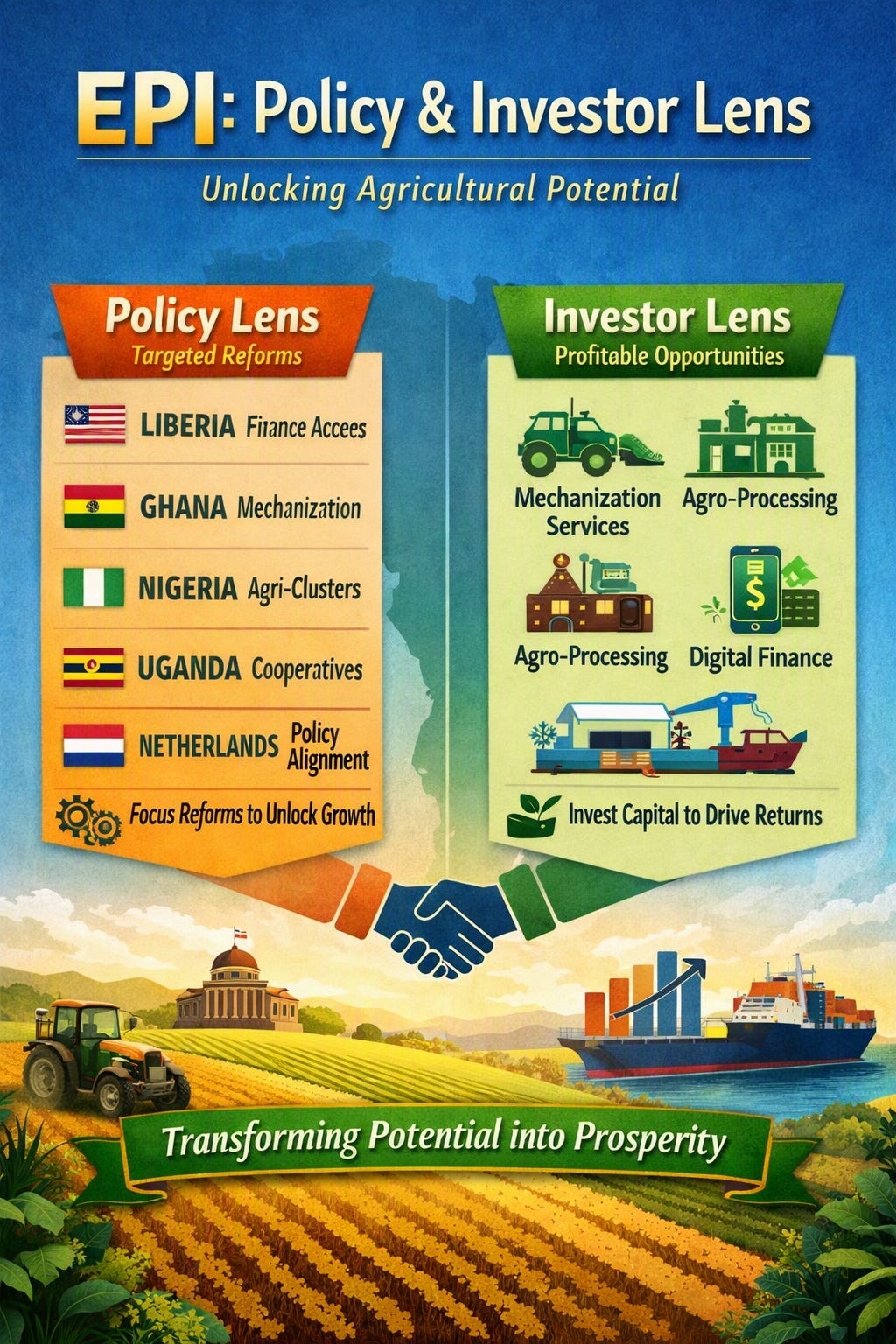
Conclusion: For governments and development partners, the EPI is a policy compass. It shows that reforms must be targeted to bottlenecks: finance in Liberia, mechanization in Ghana, clusters in Nigeria, cooperatives in Uganda, and policy alignment in the Netherlands. By focusing on these, policy makers can turn underutilized capacity into measurable growth.
“EPI is not about more spending — it is about smarter reforms that unlock the bottlenecks holding back potential.”
6. Final Conclusion – Policy Makers & Investors Together
The Economic Potential Index (EPI) reframes Africa’s economies not as weak performers, but as underutilized systems with vast reserves of land, labor, and innovation waiting to be mobilized.
For policy makers, EPI is a diagnostic compass. It shows where reforms must be targeted:
Liberia → finance reform.
Ghana → mechanization and irrigation.
Nigeria → cluster development and logistics.
Uganda → cooperative finance.
Netherlands → policy alignment. By focusing on these bottlenecks, governments and development partners can unlock growth without wasting resources.
For investors, EPI is a market intelligence tool. It highlights profitable opportunities:
Mechanization services in Ghana and Nigeria.
Agro‑processing in Liberia and Uganda.
Digital finance in Liberia and Nigeria.
Logistics and cold chain in Ghana and Nigeria. Risks exist — from infrastructure gaps to policy uncertainty — but EPI shows where structured business models (leasing, cooperatives, mobile finance) can mitigate them.
Unified Message: EPI bridges the gap between policy reform and private enterprise. Governments see where to act, investors see where to allocate capital, and both together can transform underutilized potential into prosperity.
“Africa is not short of potential. It is short of utilization. The EPI shows both governments and investors where to turn capacity into prosperity.”